
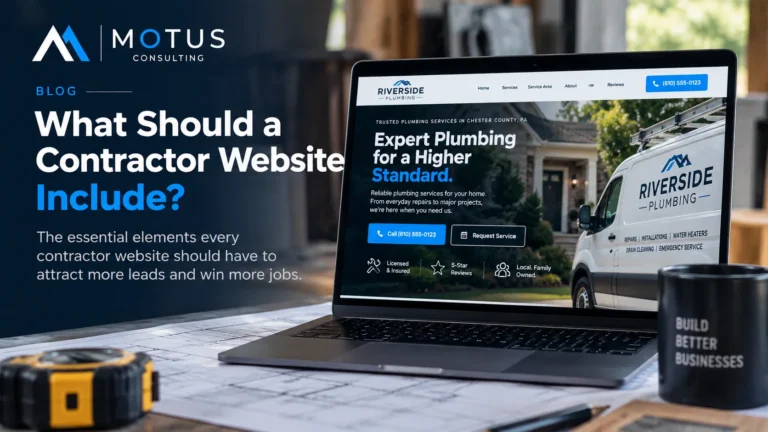
A contractor website does not need to be complicated. It does not need flashy animations, dozens of pages, or every new marketing tool available. It does need to make it easy for a potential customer to understand what you do, decide whether they trust your company, and take the next step.
That sounds obvious, but many contractor websites fail at one of those three jobs. Some look polished but make it difficult to figure out which services the company actually provides. Others contain plenty of information but bury the phone number, service area, or contact form. And some generate inquiries but have no real system for handling those leads once they come in.
A good contractor website should function as part of the business, not simply as an online brochure. Whether someone finds you through Google, an ad, a referral, social media, or the name on one of your trucks, the website often becomes one of the places where that person decides whether to contact you.
So what should actually be on it?
1. Clear Service and Service-Area Messaging
The first few seconds on your website should answer two basic questions: What do you do, and where do you do it?
Homeowners should not have to study your navigation menu or scroll halfway down the page to figure that out. If you are a plumber serving Chester County, say so. If you build patios and outdoor living spaces throughout the Main Line, make that clear. Straightforward language is usually more useful than a clever headline that could apply to almost any business.
Say what you do plainly
A headline such as “Building Better Experiences for Your Home” may sound polished, but it leaves the visitor with work to do. Are you a remodeler? A plumber? A landscaper? An HVAC company?
Compare that with something like:
Residential Plumbing Services Across Chester County
or:
Patios, Walkways & Outdoor Living Spaces Across the Main Line
The second type of headline immediately gives the visitor context. You can still communicate what makes your business different, but clarity should come first.
Make it easy to understand where you work
Your service area deserves the same treatment. A homeowner may love what they see on your website and still leave if they cannot determine whether you work in their town.
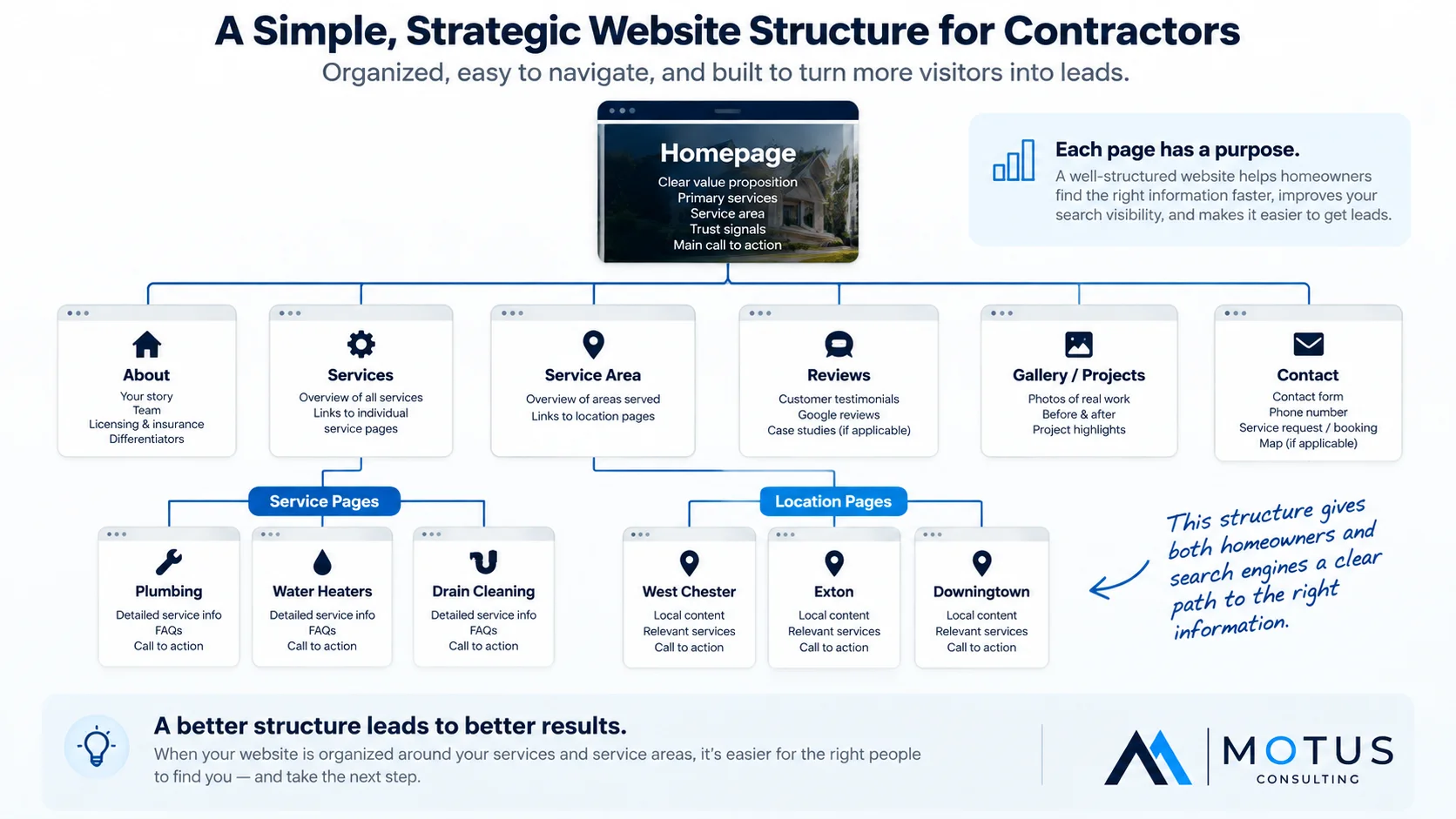
You do not need to cram a list of 40 municipalities into the top of the homepage. Instead, establish the broader area clearly and support it elsewhere on the site with useful service-area or location pages where appropriate.
The important thing is that a potential customer should not have to guess whether they are eligible to hire you.
2. A Strong Mobile Experience
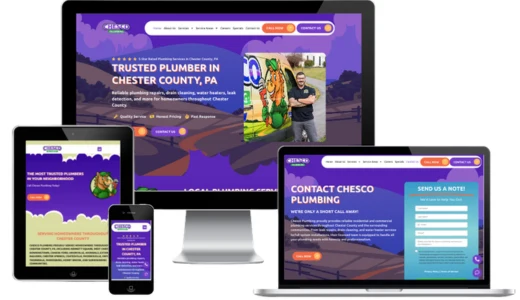
Contractors should assume that many potential customers will visit their website from a phone. That makes mobile design much more important than simply shrinking the desktop version until it fits on a smaller screen.
Someone looking for a contractor on their phone may be standing in a basement next to a failed water heater, sitting in their car between appointments, or researching a larger project from the couch. The site needs to work naturally in those situations.
Make the important actions easy to use
Phone numbers should be easy to find and tap. Buttons should be large enough to use without precision. Text should be readable without zooming, forms should fit comfortably on the screen, and navigation should not require a visitor to fight through a complicated menu.
This is also where unnecessary design elements can become a problem. A multi-column desktop section might look great on a large monitor but turn into a long, confusing stack on a phone.
The mobile experience should prioritize the information that matters most: what you do, where you work, why someone should trust you, and how they can contact you.
3. Obvious Calls to Action
Once a visitor decides they may want to work with you, the website needs to make the next step obvious.
For most home service businesses, that means calling, requesting service, requesting an estimate, sending a message, or scheduling an appointment. The exact action depends on how your company operates, but the visitor should never have to search for it.
Tell people what the button actually does
Specific calls to action are usually more useful than vague ones.
“Learn More” may make sense when someone is exploring a service, but it is less useful when you actually want them to schedule service. In that case, Schedule Service, Call Now, or Request an Estimate tells the visitor exactly what they are doing.
Calls to action should also appear naturally throughout the page. You do not need to place a button after every paragraph, but someone who becomes convinced halfway through the homepage should not have to scroll back to the top to contact you.
The objective is not to pressure people. It is to eliminate unnecessary friction.
4. Dedicated Pages for Your Important Services
A homepage can introduce your business, but it usually cannot explain every important service you offer in enough detail.
That is where dedicated service pages become useful.
If a plumbing company handles water heaters, drain cleaning, sewer repair, water treatment, emergency plumbing, and fixture installation, those services do not all need to compete for attention on one page. Each important service can have its own useful page that answers the questions someone considering that service is likely to have.
A service page should help someone make a decision
A good service page can explain what the service includes, which problems you solve, what the process may look like, why a homeowner might choose your company, and how to contact you.
It also gives search engines a clearer understanding of what the business actually offers. Someone searching specifically for water heater repair is looking for something more specific than “plumber,” just as someone searching for a patio contractor has different intent than someone searching broadly for “masonry.”
Dedicated pages allow the website to meet those more specific needs.
Do not create pages just to increase your page count
There is an important distinction between building useful service pages and mass-producing thin pages for SEO.
A website does not become better because it has 100 URLs. If five pages contain essentially the same generic copy with the service name changed, those pages are not adding much value to a potential customer.
Start with the services that actually matter to the business. Make those pages useful, specific, and easy to navigate to. Expand from there when there is a legitimate reason to do so.
5. Trust Signals That Help People Evaluate Your Company
Hiring a contractor requires trust. In many cases, the customer is allowing someone into their home, handing over a significant amount of money, or trusting that company with a problem they do not know how to evaluate themselves.
Your website should help reduce some of that uncertainty.
Use real evidence instead of generic claims
Almost every company says it provides great service. Evidence is more persuasive.
Depending on the business, useful trust signals might include customer reviews, years in business, licensing and insurance information, warranties, certifications, financing options, professional associations, photos of the actual team, branded vehicles, or examples of completed work.
Not every contractor needs every one of those elements. The goal is to show potential customers legitimate reasons to believe that the company is established, capable, and trustworthy.
Reviews are particularly useful because they provide a perspective other than your own. Rather than placing one giant testimonial section on the homepage and considering the job finished, reviews can also be used naturally on relevant service and location pages where they support the decision someone is making.
6. Real Photos Whenever You Have Good Ones
There is nothing inherently wrong with stock photography, and AI-generated imagery can be useful when a company does not have the visual assets it needs. But when you have strong real photos, they can add credibility that generic imagery cannot.
Photos of your actual technicians, crews, trucks, equipment, projects, office, or owner help a visitor understand that there is a real company behind the website.
Quality matters more than filling every section with a picture
You do not need hundreds of professional photos before launching a website. A small collection of strong images can go a long way.
At the same time, using poor-quality real photos simply because they are “authentic” is not automatically better. Dark, blurry, badly framed job-site photos can make an otherwise professional website feel unfinished.
Use the best real imagery you have. When there are gaps, high-quality stock or carefully created AI images can support the design until the business develops a stronger photo library.
7. Simple Contact Forms
A contact form should make it easier to start a conversation, not feel like paperwork.
For many contractors, the basic information needed at the beginning is fairly limited: the customer’s name, phone number, email address, service needed, and perhaps a short description of the problem or project.
If you genuinely need additional information before someone can be contacted, ask for it. But every extra required field should have a reason to exist.
Tell the customer what happens after they submit
One of the easiest details to overlook is the confirmation experience.
After someone fills out a form, they should know it worked. A simple confirmation such as, “Thanks — we received your request and a member of our team will be in touch,” removes uncertainty.
Behind the scenes, the business should also have a clear process for handling that inquiry. Someone should be notified, the lead should be recorded somewhere useful, and there should be a plan for following up.
A form that generates leads nobody responds to is not doing much for the business.
8. More Than One Reasonable Way to Contact You
Not everyone wants to communicate the same way.
One homeowner may want to call immediately. Another may be researching after business hours and prefer to send a message. Someone else may want to schedule online without talking to anyone first.
Giving people more than one reasonable way to start a conversation can reduce friction, provided your company can actually manage those channels well.
Choose contact options that fit your operation
Phone, SMS, forms, online scheduling, and website chat can all make sense in the right situation. That does not mean every contractor needs all of them.
If you offer live chat but nobody reliably monitors it, you have not improved the customer experience. If you allow online booking but your scheduling process cannot support it, you may create operational problems instead.
9. Basic Lead and Website Tracking
A contractor does not need to become an analytics expert to benefit from website tracking.
You should, however, have some understanding of whether the website is producing opportunities and where those opportunities are coming from.
Measure actions that matter to the business
Useful website events may include phone calls, form submissions, appointment requests, chat conversations, or text leads. You may also want to understand which traffic sources and landing pages are producing those actions.
This is more valuable than looking at traffic alone.
A page receiving 2,000 visits may sound impressive, but if almost nobody contacts the company, that traffic deserves a closer look. Another page may receive a fraction of the visits but consistently produce qualified inquiries.
The purpose of tracking is not to create more dashboards. It is to help you make better decisions.
Try to connect leads to actual business outcomes
The next step is understanding which leads become appointments and jobs. Not just junk volume and/or missed calls.
No attribution system is perfect, but the closer you can get to connecting marketing sources with real business outcomes, the easier it becomes to decide where your marketing budget belongs.
Clicks matter. Leads matter more. Booked jobs matter most.
10. A Sensible SEO Foundation
A contractor website should be built so search engines can understand the business, but SEO should not turn the site into something unpleasant for humans to read.
Good fundamentals are often fairly straightforward.
Give the website a clear structure
Pages should have descriptive titles, a logical heading hierarchy, readable URLs, useful internal links, and content that clearly explains the subject of each page. Core services should have appropriate pages, and businesses serving distinct geographic markets may benefit from useful location content.
Technical elements matter too. The site should work on mobile, load reliably, and provide accurate business information.
What you do not need is awkward keyword repetition designed to remind Google every three sentences that you are a “best plumber near me.”
Write a useful page about the subject first. Optimize it so search engines can understand that page second.
11. Speed and Technical Reliability
Design means very little if the site does not function properly.
Large unoptimized images, unnecessary scripts, excessive plugins, autoplaying media, and complicated effects can all make a website harder to use and maintain.
You do not need to obsess over achieving a perfect score in every website-speed testing tool. You do want a website that feels fast and dependable to the people using it.
Test the things that generate business
Periodically test your website like a customer would. Tap the phone number. Submit the contact form. Open the site on a phone. Test booking links. Click through the navigation. Make sure confirmation messages appear and that lead notifications actually reach the appropriate person.
A broken form can sit unnoticed for days while the site continues looking perfectly normal.
The details matter because small technical failures can quietly become lost opportunities.
12. A Connection to the Rest of Your Marketing
Perhaps the most important thing to understand is that your website is not a separate marketing channel.
It is often where your other marketing channels meet.
A homeowner might first hear about your company from a referral, see one of your trucks, find your Google Business Profile, click a Google Ad, discover you through organic search, or see something on social media. Even if the website was not the original source, that person may still visit it before deciding whether to contact you.
What happens after the click matters
This is why website performance cannot be evaluated only by how the site looks.
If a Google Ad generates the right click but the landing page is confusing, the website becomes part of the problem. If SEO generates traffic but the contact form is difficult to use, the website becomes part of the problem. If the website generates a strong lead but nobody follows up, the website did its job but the overall marketing system still failed.
That is why we believe contractor websites should be built as part of a broader growth system.
The website helps convert attention into an opportunity. Your CRM, notifications, automation, and team processes help determine what happens next.
What a Contractor Website Does Not Need
It is easy to take a useful website and make it unnecessarily complicated.
You do not automatically need dozens of animations, an enormous navigation menu, five popups, a chatbot covering half the screen, a 40-section homepage, or every piece of marketing technology somebody is currently selling.
Every feature should have a purpose.
If it makes the website clearer, creates useful information, improves trust, makes contacting the business easier, or helps your team handle leads more effectively, it may deserve to be there.
If it simply makes the website look busier, it probably does not.
A contractor website should feel professional without getting in the customer’s way.
A Practical Contractor Website Checklist
Before investing more money into driving people to your website, take a few minutes and look at it from the perspective of someone who has never heard of your company.
Can they immediately tell what you do and where you work? Can they easily call you from a phone? Are your important services easy to find? Does the site give them legitimate reasons to trust you? Are your contact forms short, functional, and connected to a real follow-up process?
You should also be able to answer some questions internally. Do you know when a form comes in? Can you tell which marketing channels are producing calls and leads? Does the site work properly on mobile? Are important service and location pages genuinely useful? Does the website connect cleanly to the way your team manages new opportunities?
You do not need a perfect answer to every question before your website can generate business. But if several of those basics are missing, that is usually where I would start before adding more complexity or spending substantially more money to send traffic to the site.
Need a Better Contractor Website?
At Motus, we do not view a contractor website as a standalone design project.
The website should help potential customers understand your business, trust your company, and take action. From there, the lead should enter a system that helps your team respond, follow up, track the opportunity, and ultimately turn more of those opportunities into booked work.
If your current website is outdated, unclear, or disconnected from the rest of your marketing, we can help you identify what actually needs to change.