
Why Contractors Lose Leads When Nobody Answers the Phone
You’re halfway through a job when your phone rings. Your hands are occupied, the office is on another line, and the call goes to voicemail.
You’ll call back when you’re finished.
The homeowner has a different schedule. They want to know whether someone can fix the problem, come out for an estimate, or answer a question before they commit. While you’re working, they can call the next company.
Contractors lose leads when missed calls leave homeowners waiting without a clear next step. Delayed callbacks, unclear responsibility, and forgotten follow-up turn an unanswered call into an opportunity that never becomes an appointment.
You cannot personally answer every call while running a contracting business. You can build a process that keeps those calls from disappearing.
Why homeowners call another contractor instead of waiting
Put yourself on the other end of the phone.
A homeowner with a broken air conditioner wants to know whether you have availability. Someone planning a bathroom renovation may be calling during a short lunch break. A property owner looking for tree removal needs to confirm that you handle the work.
They chose your number because something gave them enough confidence to call: your reviews, your website, a referral, or an ad.
Then they reach a generic voicemail greeting.
Now they have more questions. Is this the right number? Is the company open? Does anyone check these messages? Should they try someone else?
The urgency varies by job. A leaking water heater and a patio estimate do not require the same response. But a homeowner should be able to tell that their inquiry reached the business and understand what happens next.
That first interaction is part of the marketing foundation every contractor should have before running ads. Getting someone to call is valuable only if your business can handle the inquiry.
Five ways contractors lose leads after a missed call
The phone ringing unanswered is visible. The failures afterward are harder to notice.
1. Nobody is responsible for the callback
The owner sees the missed call and assumes the office will handle it. The office sees the same notification and assumes the owner knows the caller.
A notification sent to three people still needs one person responsible for acting on it.
Assign a primary callback owner for each coverage period and a backup for when that person is unavailable.
2. No voicemail means no follow-up
A missed call without a message tells you very little. It could be a sales call, an existing customer, or someone who needs your services but doesn’t want to leave a voicemail.
Use the call history and existing contact record to investigate. For plausible customer inquiries, make a return attempt instead of treating silence as proof that the call didn’t matter.
3. One unsuccessful callback ends the process
You return the call while the homeowner is driving or working. They miss it. You move on.
Without a recorded next action, that opportunity can sit untouched for days.
Record the attempt and decide what happens next. That may be another call during staffed hours or continuing a conversation by text if the homeowner has replied there. Stop when they decline or ask you to stop.
4. Someone answers but cannot help
An answered call can still produce a poor experience.
If the person answering cannot confirm your service area, explain the next step, or get the inquiry to someone who can help, the homeowner is still waiting.
Your call handler needs basic information: services offered, areas covered, scheduling rules, and when to escalate a question. They also need clear limits on what they can promise.
5. After-hours inquiries get buried
Morning brings dispatch changes, crew questions, deliveries, and customers already on the schedule. Yesterday’s missed calls compete with everything else.
Give after-hours inquiries their own review step when coverage resumes. Someone should work through that queue and record the outcome of each potential customer inquiry.
Test what happens when someone calls your business
Before adding software or changing staffing, call your business from a number your system won’t recognize.
Test the number on your website and any separate numbers used in advertising. Try during business hours and after closing.
Follow the experience from the caller’s side:
- Does the call reach the right person?
- How long does it ring before voicemail or backup coverage takes over?
- Does the greeting identify your business?
- Can you leave a message?
- Does the greeting explain when to expect a response?
Then check the business side:
- Where does the missed call appear?
- Who receives the notification?
- Who is responsible for returning it?
- Can the rest of the team see whether it was handled?
Leave a test message and have your team process it normally. Finding the notification is only the first step. Check whether it becomes a task, a conversation, and a recorded outcome.
A contractor website should make contacting you easy. Testing the phone number confirms that the next step works too.
Give every missed call an owner and a next action
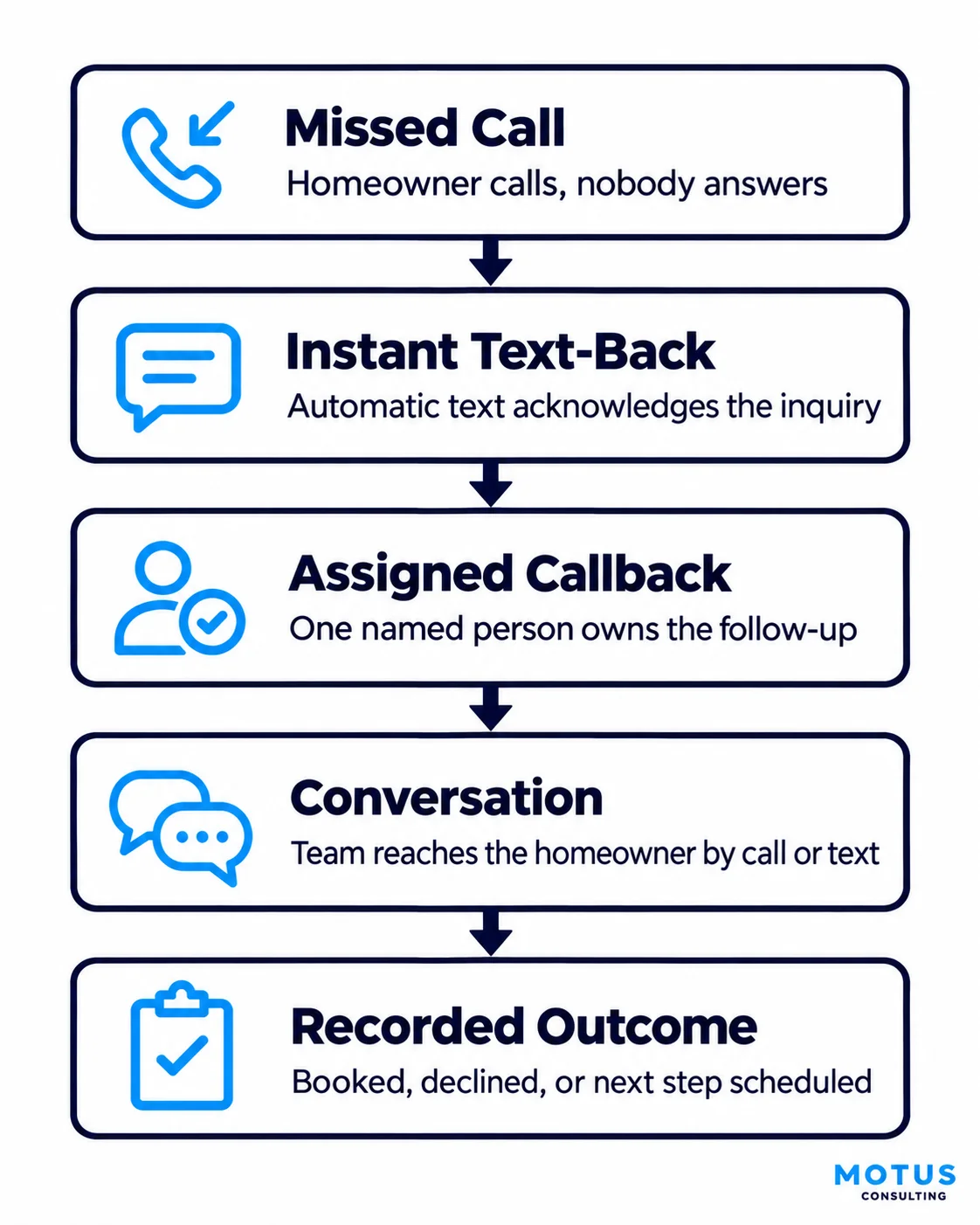
Start with a process your team can follow on a busy Tuesday.
| Situation | Required action | Who owns it |
|---|---|---|
| A call is missed during staffed hours | Review the inquiry and return the call | Assigned office staff member or owner |
| The primary person is unavailable | Take over the callback | Named backup |
| A call comes in after hours | Add it to the next staffed coverage period, or route it to actual on-call coverage | Opening staff member or on-call person |
| The homeowner misses your callback | Record the attempt and set the next appropriate action | Current lead owner |
| The homeowner books | Record the appointment and stop redundant follow-up | Person who booked it |
| The inquiry does not become an appointment | Record the reason or mark the outcome unknown | Current lead owner |
Before you end a shift or hand off the phone, look for unresolved inquiries.
Each one should show who owns it, what happens next, and when that action is due.
That gives the next person enough information to continue without asking the owner to reconstruct a conversation from memory.
Use a voicemail greeting that sets a real expectation
A useful greeting identifies the business, asks for the information needed to respond, and gives an accurate callback window.
Use this as a starting point:
“You’ve reached [Company]. We can’t answer right now. Please leave your name, callback number, town, and a brief description of the work you need. We return calls [specific callback window]. Again, this is [Company]. Thank you.”
Replace the bracketed window with something your team can deliver. For example, a project-based contractor might say that messages received after closing are returned the next business morning.
An urgent service business needs coverage that matches the services it advertises. If you offer after-hours response, explain the actual route to that service. If you don’t, say when the office reopens.
Do not tell callers to text an emergency unless someone is responsible for monitoring that number and responding.
How missed-call text-back helps contractors recover the conversation
Missed-call text-back sends a message after an unanswered call, giving the caller another way to explain what they need.
A simple message could read:
“Hi, this is [Company]. Sorry we missed your call. What service do you need, and what town are you in? You can reply here. Our team will follow up [specific callback window].”
For after-hours calls, use wording that matches your availability:
“Thanks for calling [Company]. Our office is closed. Please reply with your name, town, and the service you need. We’ll review your message when we reopen at [time/day].”
Only invite replies to a number that accepts texts and has a monitored inbox.
The useful part comes after the message. If a homeowner replies, “Water heater replacement in West Chester,” your team now has information to work with before calling.
A practical setup connects that reply to:
- The caller’s contact record.
- A notification to the assigned person.
- A visible follow-up task.
- The eventual appointment or outcome.
Once someone takes over the conversation, the workflow should stop sending unnecessary prompts. Repeat calls should not produce a pile of identical messages.
This is where CRM and automation for contractors can help: the acknowledgment, assignment, and follow-up live in the same process.
Answering service or missed-call text-back: which do you need?
Choose based on what callers need and where your current coverage fails.
| Your situation | What to consider |
|---|---|
| Callers need immediate answers or help arranging service | Live coverage with clear scheduling and escalation rules |
| You occasionally miss calls while working | Text-back paired with assigned callbacks |
| Your office answers most calls but gets overloaded | Overflow answering coverage |
| You receive project inquiries after hours | An honest after-hours message and a reliable morning follow-up process |
| Messages are captured but nobody acts on them | Fix assignment and accountability before adding another tool |
An answering service can have a conversation while your team is unavailable. Its usefulness depends on the instructions you provide and the actions it is allowed to take.
Before hiring one, ask what happens when a caller wants an appointment, asks about a service you don’t offer, or needs a decision that requires your team.
Text-back is useful when it opens a conversation your staff will continue. It won’t solve a queue of inquiries that nobody checks.
You may need both. For example, live coverage can handle overflow while text-back catches calls that still go unanswered. Test the combination so callers receive a consistent response.
Track recovered leads without inflating the numbers
A missed-call count is a starting point. It does not tell you how many unique sales opportunities you missed or recovered.
Here is a hypothetical example:
| Call-log review | Count |
|---|---|
| Total unanswered calls | 12 |
| Spam calls | 4 |
| Additional attempts from repeat callers | 2 |
| Unique potential customer inquiries | 6 |
| Potential customers successfully reached | 4 |
| Appointments booked | 2 |
The six potential customers are the group worth investigating. The two appointments show a useful result from follow-up. The remaining inquiries need an outcome or a next action.
This is more informative than labeling all 12 calls “lost jobs.”
For your own review, track:
- When the original call came in.
- Whether it was a new customer inquiry.
- When the first callback happened.
- Whether you reached the person.
- Whether they booked.
- Why they didn’t book, when known.
Keep “attempted contact” separate from “spoke with customer.” Otherwise, a report can suggest that every lead was handled even when half the homeowners were never reached.
Look for patterns. If unresolved calls concentrate around lunch, you may need overlapping coverage. If replies arrive after closing and sit until midday, the morning handoff needs attention.
Do missed calls affect Google Local Services Ads?
Google lists responsiveness to customer inquiries as a factor in Local Services Ads ranking and explicitly notes that missed calls may negatively affect responsiveness. Google’s current Local Services Ads ranking guidance explains this alongside other factors, including relevance and profile quality.
Responsiveness is one factor, so missed calls alone do not explain every change in ad placement.
They do deserve attention when reviewing campaign performance. Check whether the calls generated by your advertising reach someone who can help, and whether unanswered inquiries receive follow-up.
A campaign report can show calls coming in while your appointment calendar stays quiet. Connecting those calls to their outcomes helps you distinguish a targeting problem from a call-handling problem.
Review your last ten missed calls before increasing your budget
Open your call log and work through the last ten unanswered calls.
For each one, answer:
- Was this a potential customer?
- Who was responsible for following up?
- Did anyone reach them?
- What happened next?
If the answer is unknown, identify where the record stops.
Then fix the most frequent problem. That might mean assigning a backup, changing your voicemail, adding a callback task, or adjusting coverage during your busiest hour.
Review the next ten after making the change. You should be able to see whether more inquiries are getting a response and whether fewer are left unresolved.
Frequently asked questions about contractor missed calls
How fast should a contractor return a missed call?
Return potential customer calls as soon as your staffed coverage allows. Urgent service inquiries need prompt attention because homeowners may be arranging help immediately. For planned projects, provide a clear callback window and meet it. Track the time until an actual conversation separately from the time until an automated acknowledgment.
Should contractors use an answering service or missed-call text-back?
Use an answering service when callers need a live conversation, scheduling help, or immediate routing. Use missed-call text-back to acknowledge unanswered calls and let homeowners reply with details. Both require someone responsible for the next action; the right choice depends on call volume, urgency, and existing coverage.
Should you return a missed call if the caller didn’t leave a voicemail?
For plausible customer inquiries, yes. Check the number against your contacts and call history first. A missing voicemail doesn’t explain why the person called. A return attempt can help establish whether they need your services.
Do missed calls hurt Local Services Ads ranking?
They can affect responsiveness, which Google considers in Local Services Ads ranking. Google does not publish a fixed ranking penalty for each missed call. Review call coverage as part of overall account performance rather than assuming a single missed call caused a placement change. Source: Google.
Start With the Calls You’re Already Getting
Before increasing your marketing budget, review your last ten missed calls. Find out who followed up, whether they reached the homeowner, and what happened next. If those answers are hard to find, you have a specific place to start: assign callback responsibility, keep unresolved inquiries visible, and record the outcome.
You don’t need to be available every minute of the day. You need a dependable process for the times you aren’t. A homeowner who calls while you’re working should still have a way to explain what they need and hear back from someone who can help.
A Website That Captures Leads. Automation That Follows Up.
Motus’s foundational offer connects your website with missed-call text-back, lead notifications, and follow-up automation. Your inquiries stay organized in one dashboard, making it easier to see who needs a response and what happens next.
For $499 upfront and $297 per month, we upgrade your website and put the follow-up system behind it. If you’re getting calls but handling callbacks through memory and scattered messages, this is a practical place to start.