
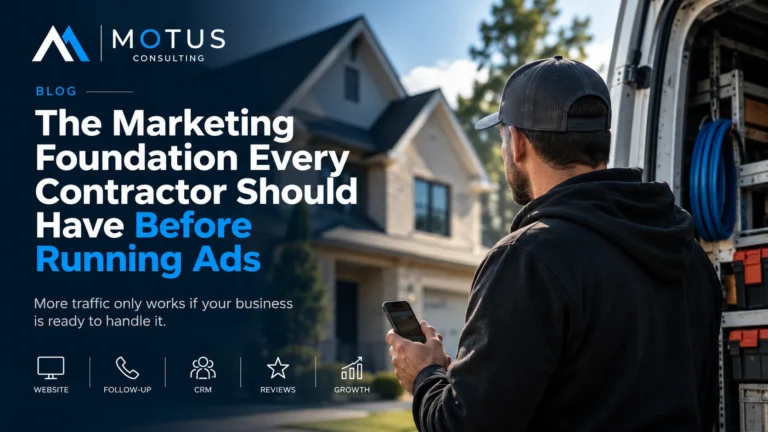
Paid advertising can be a powerful way to grow a home service business. It can also be an expensive way to expose every weakness in the system behind your marketing.
A contractor turns on Google Ads, Meta Ads, or Local Services Ads expecting more business. The phone starts ringing, forms begin coming in, and traffic increases. But then calls get missed, leads sit too long, prospects land on a weak website, follow-up is inconsistent, and nobody can say with confidence which opportunities actually turned into booked work.
The conclusion is usually simple:
“The ads aren’t working.”
Sometimes that is true. But sometimes the real problem started before the ad was ever launched.
At Motus, we believe contractors should have a basic marketing foundation in place before aggressively increasing ad spend on lead generation. That does not mean every system needs to be perfect. It means the business should be reasonably prepared to turn attention into a conversation, a booked appointment, and eventually a customer.
Here is what that foundation looks like.
1. A Website That Makes the Next Step Easy
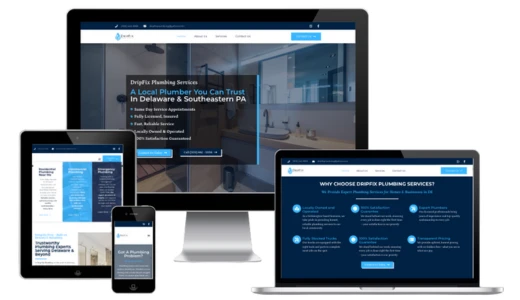
A contractor website does not need to win design awards. It does need to help a potential customer understand what you do, decide whether you are credible, and figure out how to contact you.
That sounds basic, but a surprising number of contractor websites make people work too hard to answer those questions.
Start with clarity
Imagine someone searching for a plumber because water is coming through their ceiling. They are not carefully reading your company history or comparing design details. They want to know whether you handle the problem, whether you serve their area, whether your company looks legitimate, and how quickly they can reach you.
Your website should answer those questions without forcing the visitor to hunt for the information.
That usually means clear service messaging, obvious calls to action, visible phone numbers, straightforward forms, mobile-friendly design, useful trust signals, and content that sounds like it was written for an actual homeowner.
The website should support conversion, not just exist
The goal is not simply to “have a website.” The goal is to have a website that helps turn traffic into opportunities.
If someone visits your site and cannot quickly understand what you do or how to contact you, sending more traffic does not solve the underlying problem. It simply exposes more people to the same friction.
2. A Plan for Missed Calls
Contractors spend a lot of money trying to make the phone ring. Then someone calls while the owner is on a job, the office is busy, or the business is closed.
The call goes unanswered.
That does not automatically mean the lead is lost, but it creates a risk. Many homeowners will simply move to the next company if you they do not hear anything back.
Missing a call is not the real problem
No company answers every call. The bigger issue is what happens next.
A simple missed-call text-back system can help keep the conversation alive. When someone calls and nobody answers, the system can immediately send a message acknowledging the call and asking how the business can help.
That does not replace a real callback. It simply gives the lead a response instead of silence.
The important distinction is this:
The problem is not necessarily that you missed a call. The problem is when nothing happens after you miss it.
If you are paying to generate leads, you should have a plan for the ones you cannot answer immediately.
3. A Simple Way to Manage Leads
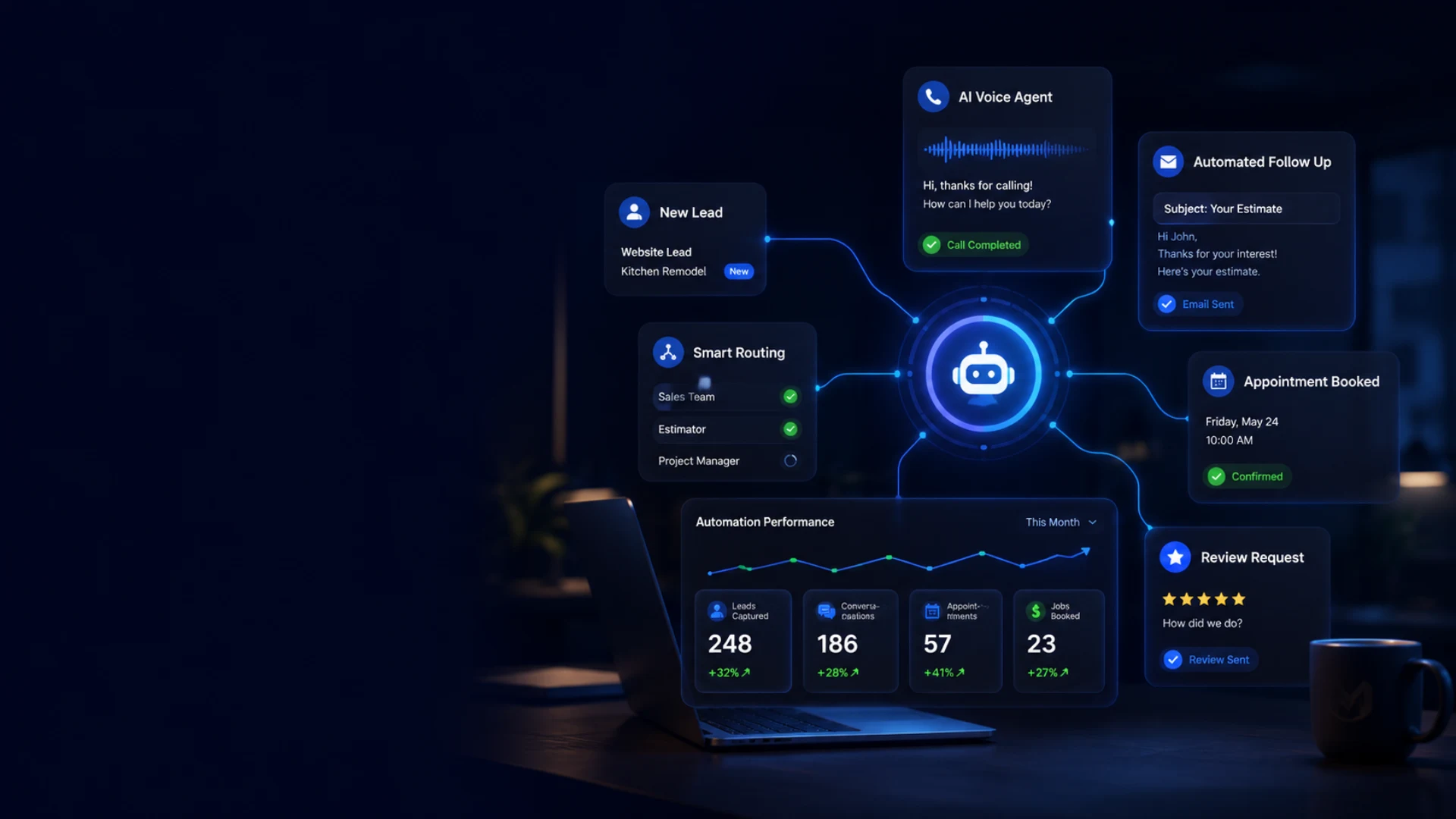
You do not need a complicated CRM with dozens of stages, dashboards, and automations just because someone told you that you should have one.
You do need a reliable way to know what happened to your leads.
You should be able to answer basic questions
At minimum, you should be able to tell:
- who contacted you
- where the lead came from
- whether someone responded
- whether the lead booked
- whether an estimate was provided
- whether the lead became a customer
- whether another follow-up is needed
Without some kind of system, leads end up scattered across text messages, email inboxes, voicemail, sticky notes, and people’s memories.
That may feel manageable when lead volume is low. It becomes much harder to manage as the business grows.
The point of a CRM is visibility
A CRM should make it easier to see what needs attention, not make the business more complicated.
The value is knowing where each opportunity stands and what should happen next. If your team cannot tell which leads are active, which ones need follow-up, and which ones turned into jobs, it becomes difficult to evaluate your marketing accurately.
4. Fast, Consistent Follow-Up
Generating a lead is only one part of the process. Someone still has to respond.
This is where many marketing systems break down. The ad may have worked, the website may have worked, and the customer may have raised their hand, but the business does not have a reliable process for what happens next.
Define what happens after a lead comes in
If someone fills out a form on your website, does the customer receive confirmation? Does your team get notified? Is one person responsible for responding? What happens if the lead does not answer the first call?
Those questions may sound operational rather than marketing-related, but they have a direct impact on marketing performance.
A campaign can generate legitimate opportunities and still produce poor business results if the follow-up process is weak.
Cost per lead only tells part of the story
This is why we do not like evaluating marketing solely by cost per lead.
A low-cost lead that never receives a response is not valuable. A more expensive lead that becomes a profitable job may be much more important to the business.
Marketing should connect to the sales process. Otherwise, you are only measuring the first half of the system.
5. More Than One Way to Start a Conversation
Not every potential customer wants to call immediately.
Someone may be researching after hours. Another person may be at work and unable to make a phone call. Someone else may prefer to send a message and wait for a response.
Giving people a few reasonable ways to start a conversation can make the website easier to use.
Use contact options your business can actually support
Depending on the business, that might include phone calls, forms, text messaging, online scheduling, or website chat.
AI-assisted chat can also be useful for answering basic questions and collecting lead information, provided it is set up carefully and connected to a real follow-up process.
The technology itself is not the main point. The goal is to reduce friction and make it easier for interested people to take the next step.
If you add a contact option, make sure your team is prepared to manage it. A chat widget that nobody monitors or an online booking system that creates scheduling problems can make the experience worse rather than better.
6. A Consistent Review Process
Most contractors understand that reviews matter. The problem is that review generation often depends on someone remembering to ask.
A job is completed, the customer is happy, and someone says, “Would you mind leaving us a Google review?”
Then everyone moves on to the next job.
Make review requests part of the process
A better approach is to make the request part of the normal customer workflow. After a successful job, the customer can receive a review request without relying entirely on someone remembering to send it manually.
That does not mean bombarding customers with messages. It means building a simple, consistent process instead of leaving it to chance.
Reviews help after someone finds you
Reviews are often discussed as an SEO tactic, but their value is broader than that.
They also help potential customers evaluate the business. A homeowner comparing several similar companies may see comparable services, websites, and pricing. A strong body of recent, credible reviews can make that decision easier.
7. Basic Tracking
Before spending more money on marketing, you should have some understanding of what is already producing opportunities.
You do not need perfect attribution. In practice, perfect attribution is difficult even with sophisticated systems.
You do need enough visibility to make better decisions.
Start by tracking lead sources
At minimum, try to understand whether calls and form submissions are coming from sources such as:
- Google Ads
- Google Business Profile
- Organic search
- Local Services Ads
- Meta
- referrals
- repeat customers
- other marketing channels
That alone gives you a much clearer picture than putting every lead into one generic bucket.
Then look at booked work
The next question is more important: which sources are producing actual jobs?
A marketing channel may generate a lot of inquiries and relatively little revenue. Another may generate fewer leads but produce stronger customers.
That is why clicks and leads should not be the final measure of success.
Booked jobs matter more.
The Real Question: What Happens After Someone Finds You?
A lot of contractor marketing starts with one question:
“How do we get more leads?”
It is not a bad question. It is just incomplete.
A better question is:
“What happens when we get one?”
Imagine two contractors spend the same amount on advertising and both receive 20 legitimate inquiries.
Contractor A has an outdated website, misses calls with no response, follows up inconsistently, and is not sure where the leads came from.
Contractor B has a clear website, missed-call text back, lead notifications, a CRM, a follow-up process, and a consistent review system.
They bought the same traffic.
They did not build the same system around it.
That is why increasing ad spend is not always the first move. Sometimes the better move is fixing what happens before and after the lead arrives.
You Do Not Need a Perfect System Before You Market
There is a risk of taking this argument too far.
You do not need to spend six months building the perfect technology stack before trying to grow. Your website does not need to be flawless, every automation does not need to be sophisticated, and your CRM does not need 37 different stages.
The goal is simply to eliminate the obvious holes.
Get the basics working first
Before putting meaningful money into generating additional demand, you should be reasonably confident that people can understand what you do, contacting you is easy, missed opportunities receive a response, leads have somewhere to go, someone is responsible for follow-up, happy customers are asked for reviews, and you can get a reasonable idea of which marketing is producing results.
Once those basics are in place, adding SEO, Google Ads, Meta Ads, Local Services Ads, or other growth channels becomes much more useful.
You are no longer buying leads and hoping the business catches them. You are sending opportunities into a system designed to handle them.
Start With the Foundation, Then Add Fuel
At Motus Consulting, this is how we think about contractor marketing.
The website, follow-up, reviews, CRM, automation, and lead tracking are not separate little tactics. They are the foundation that supports the channels used to create more demand.
SEO and advertising help bring more people into that system. The foundation helps determine what happens when they arrive.
When those pieces work together, marketing becomes easier to understand. You know how prospects found you, what happened when they reached out, whether they booked, and what happened to the opportunities that did not convert immediately.
That is when the growth question becomes more useful:
How do we get more of the right people into this system?
That is a much stronger place to start scaling from than simply spending more money and hoping more leads solve the problem.
Need to Build the Foundation First?
If you know your business needs better marketing but are not sure what should come first, Motus can help you identify the gaps and put the right foundation in place.
We help contractors connect their website, lead capture, CRM, follow-up, reviews, and tracking so the pieces work together instead of operating as separate tools.