

Quick answer: A commonly used planning benchmark for established home-service contractors is around 5–10% of revenue, and newer or fast-growing companies often spend more. But the percentage should come out of your planning, not go into it. The right budget comes from working backward from your revenue goal, using your average job value, margins, close rate, and capacity. And it only pays off if your business can actually answer, follow up on, and book the leads it pays for.
Ask ten contractors how much a business should spend on marketing and you’ll get ten answers. Some say 5% of revenue, some say 10%, and a few growth-minded owners spend well beyond that.
A benchmark range is a useful reference point, but it isn’t a strategy. A contractor doing $2 million with three trucks sitting idle has a very different marketing problem than a contractor doing $2 million who’s booked out six weeks. Same revenue, same percentage, completely different right answer.
So instead of asking “What percentage should I spend?”, ask this: “How much can I invest to win new customers and still grow profitably?”
Work Backward From the Goal
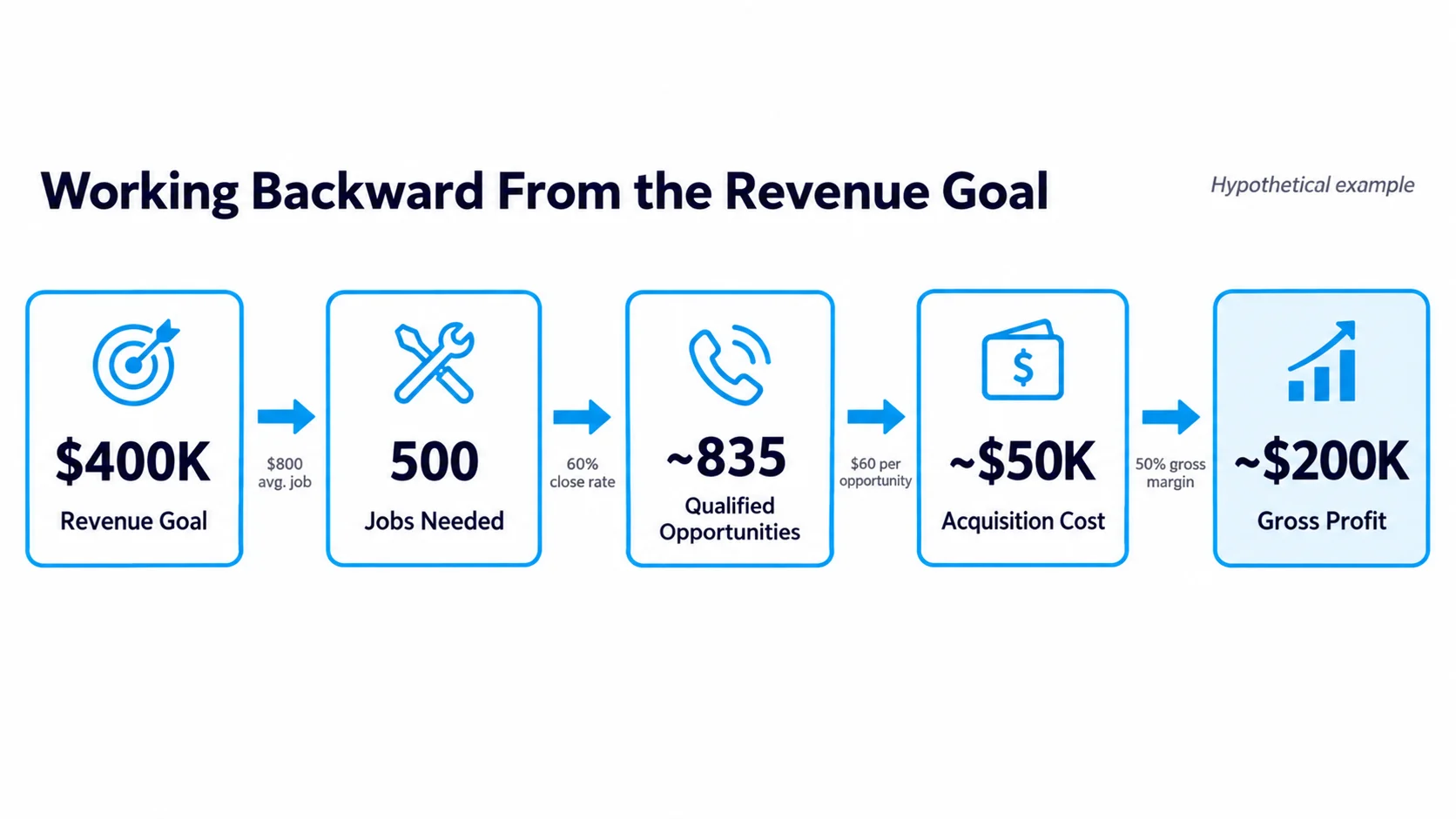
Here’s a hypothetical example using round numbers to show how the calculation works. Your own close rate, job value, and margins will be different, and they’re what matter.
Say a plumbing company does $2 million a year and wants to hit $2.4 million next year. That’s $400,000 in new revenue that has to come from somewhere.
Step one: how many jobs is that? At an $800 average job, $400,000 is 500 additional completed jobs.
Step two: how many opportunities does that take? If 60% of qualified opportunities turn into completed jobs, 500 jobs requires about 835 qualified opportunities.
Step three: what do those opportunities cost? If the company’s channels produce a qualified opportunity for about $60, then 835 opportunities costs roughly $50,000. That works out to about $100 per booked job.
Step four: is that profitable? At a 50% gross margin, each $800 job produces $400 in gross profit. Spending $100 to acquire it leaves $300. Across 500 jobs, $50,000 in growth spend produces about $200,000 in gross profit. That’s a good trade.
Now add the budget the company already needs just to keep existing demand flowing: the website, reviews, Google Business Profile, and the campaigns that keep the phones ringing today. Say that’s about $100,000. The total comes to roughly $150,000, or a little over 6% of the $2.4 million target.
It lands inside the typical range, but notice how it got there. Nobody picked 6%. It came out of the math. If the goal, the job value, or the margin changes, the number changes with it. That’s the whole point.
A few things will shift your version of this calculation. Repeat customers, maintenance agreements, and referrals reduce how much new demand marketing has to create. Higher-ticket work, like replacements or remodels, can support a much higher cost per opportunity. And your real cost per opportunity varies by channel, which is why tracking matters.
The Leak That Wrecks the Math
Now take the same hypothetical company and change one thing: say 30% of inbound calls go unanswered and never get a callback.
The company still spends $50,000 and still generates about 835 opportunities. But only about 585 of them ever reach a person. At the same 60% close rate, that’s roughly 350 jobs instead of 500.
That leak costs about $120,000 in lost revenue, and the cost per booked job jumps from $100 to about $143. To actually hit the 500-job goal, the company would need to spend roughly $71,000. That’s an extra $21,000 a year spent buying new leads to replace the ones it dropped.
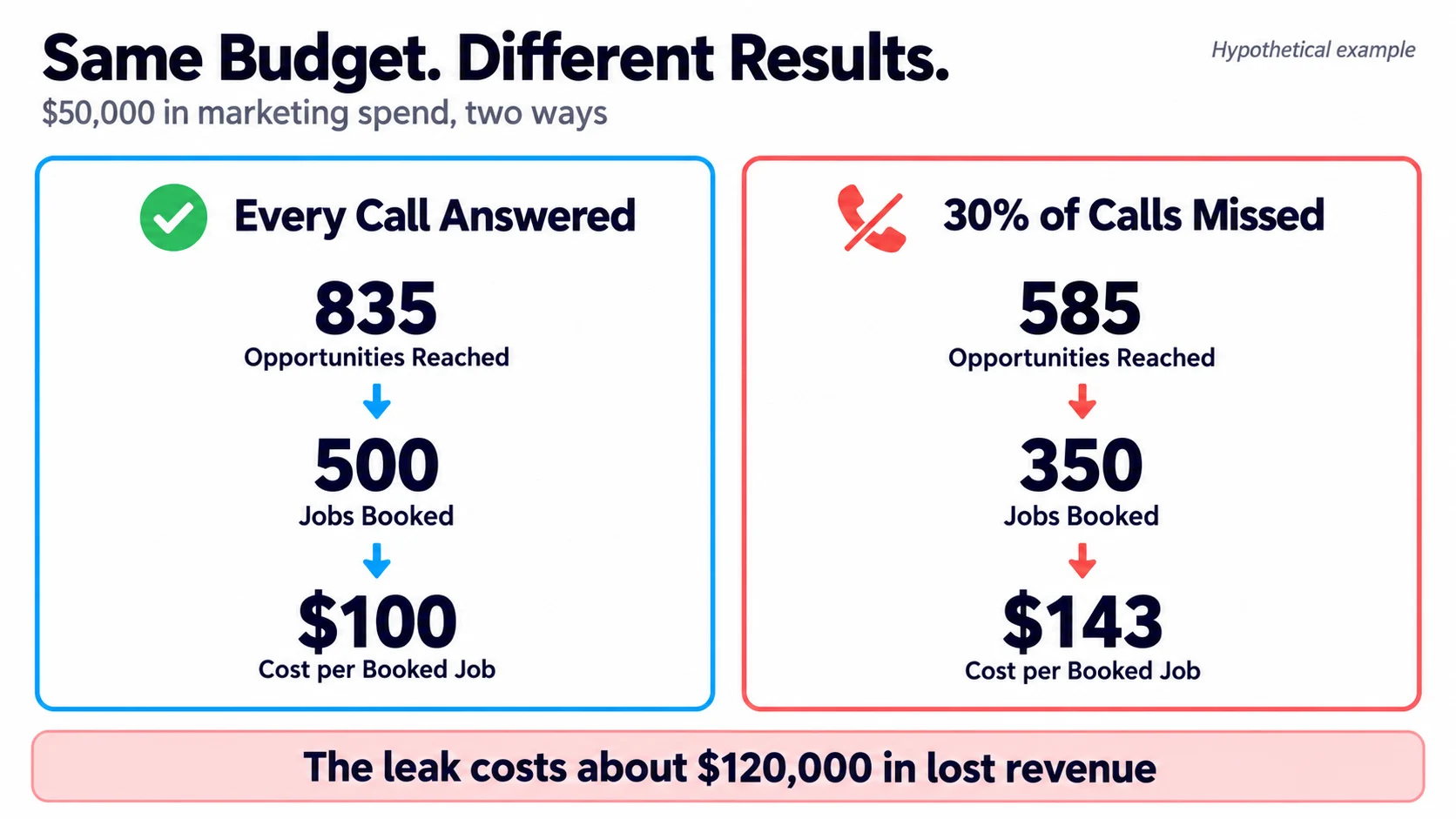
This is the part most budget conversations skip. Two contractors can spend the exact same amount and get completely different results, and the difference usually isn’t the ads. It’s what happens after the phone rings. Leads that wait until the next day, estimates nobody follows up on, and a website that makes it hard to call all push up your real cost per job.
This is why we tell contractors not to increase ad spend until the basic lead-handling system works. More leads poured into a leaky system mostly means more waste. We go deeper on this in Why Contractors Lose Leads When Nobody Answers the Phone.
Your Marketing Budget Is Bigger Than Your Ad Budget
“Marketing budget” and “ad spend” are not the same thing. A contractor’s full marketing investment usually includes Google Ads, Local Services Ads, and Meta ads, but also the website, local SEO, Google Business Profile management, call tracking, CRM and follow-up automation, review generation, email and text campaigns, photo and video, and any agency or in-house marketing help.
If you spend $5,000 a month on Google but nothing on what happens after the click, your marketing system is underfunded, no matter how healthy the ad budget looks. For many contractors, the best next dollar isn’t more ad spend. It’s fixing the website, setting up tracking, or making sure missed calls get an instant text back.
What Changes for a Smaller Contractor
At $600,000 in revenue, a contractor considering roughly $3,500 a month in marketing shouldn’t automatically put most of it into ads. If the website is weak, calls go unanswered, or the Google Business Profile is neglected, part of that budget will likely earn a better return fixing those fundamentals first. Once the path from click to booked job works, more of the budget can shift toward generating demand.
The right mix depends on your trade, your market, and where your leads are leaking. A roofer and a plumber at the same revenue can need very different splits. The principle doesn’t change: fund the foundation before you scale the traffic. A small shop can’t afford to lose a third of a limited lead flow to voicemail.
Three Questions That Decide How Aggressive You Get
Can you handle the work? Marketing can’t fix an operations problem. If you’re booked for weeks and your office can’t keep up with current call volume, more leads will make the customer experience worse. But if trucks sit idle three days a week, underinvesting is expensive too, because unused capacity is lost money.
How profitable is the work you’re chasing? A $200 lead that reliably turns into a $6,000 project is a great lead. A $40 lead that never books is a bad one. Judge channels by the cost of acquiring a profitable customer, not by cost per lead.
Do you know what’s working? Don’t scale a budget you can’t measure. At minimum, you should be able to connect your major lead sources to calls, form fills, booked appointments, and completed jobs. Attribution will never be perfect, but if you can’t tell a referral from a Google Ads lead, raising the budget is guesswork.
Maintenance Budget vs. Growth Budget
It helps to split your spending into two buckets.
A maintenance budget protects the demand you already have: staying visible on Google, keeping the website healthy, collecting reviews, and replacing customers who naturally drift away. For established contractors, this usually sits toward the lower end of the typical range.
A growth budget funds new trucks, new service areas, new service lines, or a real jump in revenue. That’s where the backward math above comes in.
Your budget has to match your ambition. You can’t set an aggressive growth target and fund marketing like a maintenance business.
How to Set Your Budget in Six Steps
- Set the revenue target for the next 12 months.
- Separate out what’s already coming in: repeat customers, maintenance agreements, referrals, and existing pipeline. What’s left is the revenue marketing has to create.
- Convert that to opportunities using your real average job value and close rate.
- Check it against gross profit. Work out what you can afford to pay per booked job and still make money.
- Confirm capacity. Make sure you can answer, schedule, and complete the extra work.
- Start controlled and scale what works. Spend enough to get meaningful data, then move money toward the channels producing profitable booked jobs.
Before step one, make sure the foundation is in place. We cover exactly what that includes in The Marketing Foundation Every Contractor Should Have Before Running Ads.
The Percentage Is the Benchmark. The Economics Determine the Budget.
Start with your revenue goal. Work backward through average job value, close rate, margins, and capacity. Then make sure your system can actually capture and follow up with the opportunities you’re paying to create.
A contractor spending 6% with a strong lead-handling system can outperform one spending 10% into a leaky one.
Frequently Asked Questions
What percentage of revenue should a new contractor spend on marketing?
New businesses usually need to spend a higher percentage than established ones because they’re starting with no reviews, no search visibility, and no referral base. Treat year one as an investment in building those assets, and focus first on a website and Google Business Profile that convert.
Does my marketing budget include my agency or software fees?
Yes. Your true marketing investment includes everything it takes to generate and convert leads: ad spend, agency or staff costs, your website, and tools like call tracking and CRM. Leaving them out makes your cost per job look better than it is.
Should I base my budget on current revenue or target revenue?
Base it on your target. If you budget off where you are today, you’ll usually fund a business that stays where it is. The backward method above builds the budget around where you’re trying to go.
How do I know if I’m spending too much?
Look at cost per booked job compared to the gross profit per job, not just cost per lead. If each dollar still produces profitable work and you have the capacity to handle it, you probably aren’t overspending. If lead volume is rising but booked jobs aren’t, the problem is usually lead handling, not the budget.